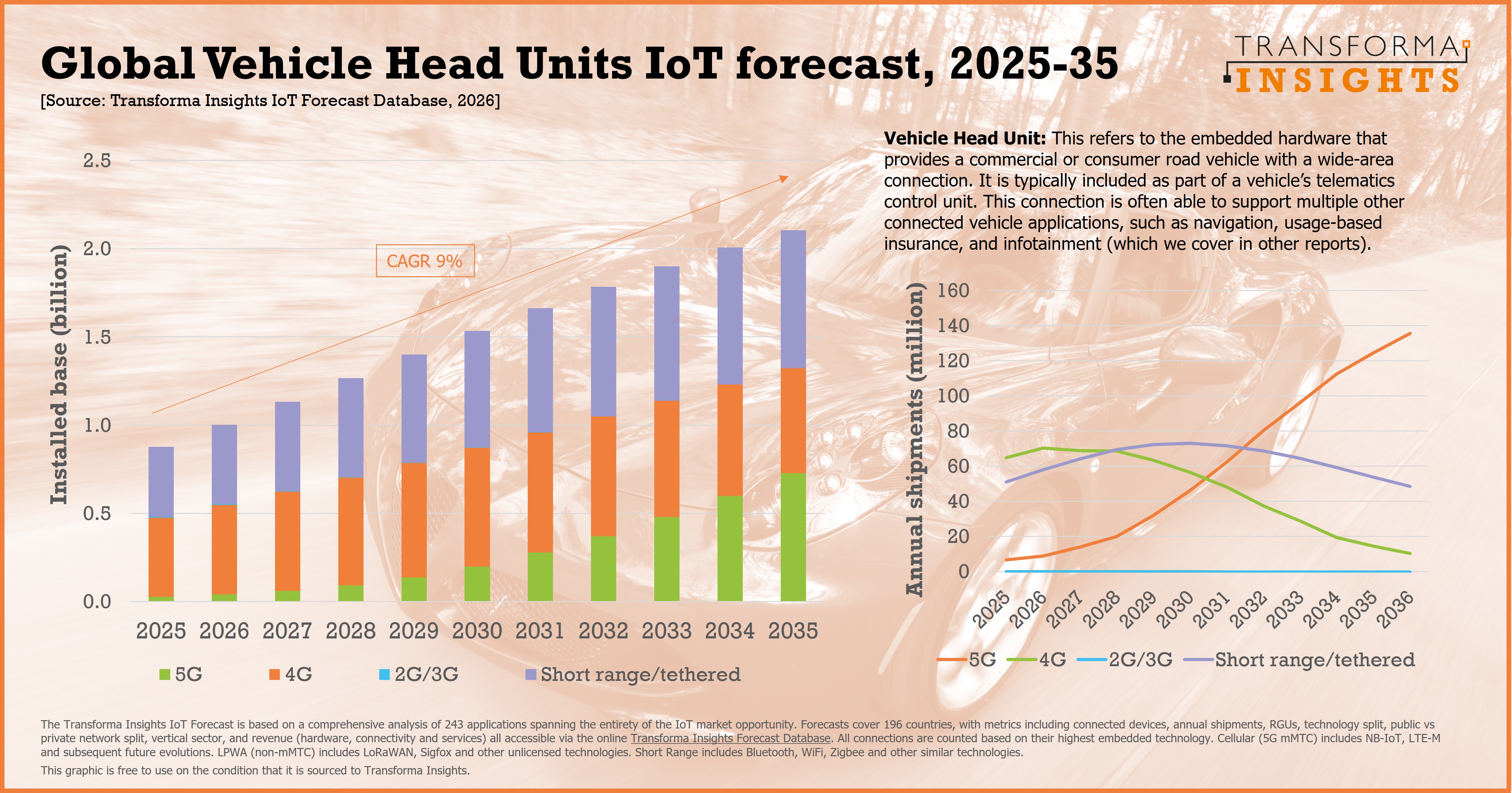
The world’s leading IoT analyst firm, Transforma Insights, estimates that the global connected vehicle fleet will grow from 876 million in 2025 to 2.1 billion in 2035, by which time it will generate IoT revenue of USD72 billion annually.
Transforma Insights recently published two reports looking at two key aspects of automotive IoT. The first analyses the market size and dynamics for Vehicle Head Units (i.e. factory-fitted vehicle connectivity), which is the arguably the single most important IoT use case. The second delves into assessing the state of software defined vehicles.
Connected vehicles: a market of 2.1 billion connections and USD72 billion
The recently published report ‘Vehicle Head Units: 2.1 billion connected cars in 2035 to drive new revenue streams for auto OEMs’ provides an overview of the current state of connected vehicles and how the market is evolving. This is further supported by forecast figures for connected devices, network technologies, and revenue for the period 2025–35.
The key highlights from this report are:
Globally, the total number of connected vehicles will more than double over the next decade, from 876 million at the end of 2025 to 2.1 billion at the end of 2035. Today, 4.3% of all Internet of Things connections are Vehicle Head Units and by 2035 it is expected to reach 4.6%.
Connected vehicles unit annual sales is expected to grow from 137 million in 2025 to 194 million in 2035.
The total IoT revenue, defined as that generated by connectivity, application and connectivity module, from vehicle head units was USD26.6 billion in 2025, a figure which will grow to USD72 billion in 2035.
Connectivity revenue, i.e. that accrued by Mobile Network Operators and MVNOs, will grow from USD2 billion in 2025 to USD5.6 billion in 2035.
The technologies of choice for connecting vehicles will transition quite rapidly. The most fundamental split is between those vehicles that rely on tethering to the driver’s handset for connectivity versus those that rely on a dedicated cellular connection. In 2025 tethered vehicles account for 45% of connections, a figure which will fall to 37% in 2035.
Vehicles using cellular will evolve over the period from 4G/LTE to 5G as the highest generation of technology (although the vast majority of 5G will be multi-mode 4G/5G). In terms of annual shipments, 5G will grow from 11% in 2025 to 93% in 2035. Although initially touted as a critical enabler for the automotive market, 5G adoption has been relatively slow, albeit faster than in many other IoT markets. Currently, 5G is largely chosen for its greater longevity and bandwidth compared to 4G, rather than for advanced network features. Automotive OEMs tend to have a keen sense of future-proofing, since the connectivity hardware they fit will often need to function for a decade or more. By 2035, 4G network availability throughout the lifetime of new models will no longer be guaranteed in many markets, up from a handful today, and 5G will be the dominant technology for new vehicles.
The impact on the installed base will be more gradual due to the long life-span of connected vehicles. In 2025, 93% of cellular connected vehicle head units used 4G, 6% 5G and 1% legacy 2G/3G. By 2035 that will have flipped to 45% 4G and 55% 5G.
Greater China represents the largest region for connected vehicles, followed by North America. India & South Asia and South East Asia are the fastest growing markets with 20% and 18% CAGR respectively during 2025-35 due to rising disposable income along and the popularity of two-wheelers. By the end of 2035, those two regions will combine to account for 23% of the total connected vehicle fleet, behind only Greater China.
We should note that factory fitted Vehicle Head Units does not represent the entirety of the automotive IoT market. Aftermarket devices continue to be deployed in large volumes. Around one-third of the connected vehicles space is accounted for by aftermarket devices. These aftermarket devices are examined in detail in other Transforma Insights reports.
An evolution to software-defined vehicles
Gone are the days when automotive OEMs used to solely focus on the engine, design, and performance of vehicles; the industry is witnessing a transition from hardware-centric to software-centric vehicles, enabling OEMs to introduce new functionalities with over-the-air updates. In our recent report ‘Software-defined vehicles: software takes a front seat in the automotive industry’, we present detailed insights on the paradigm shift occurring in the automotive industry, which at the core means making vehicles connected, modular, and programmable by decoupling hardware from software through standardised interfaces, centralised computing, and modular architectures.
Some of the conclusions from the report are:
The priority for OEMs has shifted toward delivering a comprehensive and feature-rich in-vehicle experience. Modern consumers increasingly want their vehicles to understand their lifestyle, habits, and daily routines while offering intelligent, personalised recommendations informed by the data their vehicles collect.
SDVs offer a range of benefits to automakers and consumers alike. Automotive OEMs can achieve faster design and development of advanced and next generation vehicles with the potential to update and add vehicle functionalities remotely after vehicles have been sold, using wireless network technologies. On the other hand, vehicle users can experience better infotainment and in-vehicle services supported by the integration of AI and connectivity. Also, round-the-clock vehicle monitoring can result in early identification of vehicle issues with remote diagnostics, preventing downtime and service centre visits.
Delivering ubiquitous connectivity is becoming crucial in vehicles which are being equipped with sophisticated hardware components, including sensors and cameras, and are increasingly integrated with AI algorithms, to provide a broad range of connectivity-enabled features. Vehicle features vary across regions and OEMs must account for this regional nuance and develop strategies to offer region-specific connectivity-based features to gain consumers’ interest.
About the reports
The two reports referenced above are available as part of Transforma Insights' Advisory Service.
The ‘Vehicle Head Units: 2.1 billion connected cars in 2035 to drive new revenue streams for auto OEMs’ provides a detailed definition of the automotive sector, analysis of market development and profiles of the key vendors in the space. It also provides a summary of the current status of adoption and Transforma Insights’ ten-year forecasts for the market. The forecasts include analysis of the number of IoT connections by geography, the technologies used (including splits by 2G, 3G, 4G, 5G, LPWA, Short Range, satellite, and others), as well as the revenue split between module, value-added connectivity, and services. Full detail of country-by-country forecasts with revenue and technology splits are accessed via Transforma Insights’ ultra-granular IoT Forecast Database.
The ‘Software-defined vehicles: software takes a front seat in the automotive industry’ report discusses software-defined vehicles (SDVs) in detail providing insights into how automotive OEMs and technology businesses are embedding software into vehicles. It also highlights how connectivity plays a key role by binding together various elements of a vehicle and also the remote capabilities to deliver required features.
If you have questions concerning the methodology, either general or specific to a particular application or vertical sector, don’t hesitate to contact our analysts via enquiries@transformainsights.com.