Deploying cross-border cellular IoT solutions will often introduce regulatory challenges. Companies must navigate a complex landscape of local telecommunications, spectrum, and data regulations to ensure their devices operate legally and securely in foreign countries. This report examines the regulatory environment surrounding cellular IoT, highlighting some of the key regulatory themes that could create friction in multi-national deployments. It examines the regulations that companies must consider when deploying or importing cellular IoT solutions into different countries. Understanding and adhering to these rules is essential for avoiding penalties, ensuring uninterrupted service, and enabling the seamless operation of cellular IoT devices worldwide. In this report, we examine four key areas of regulation: Permanent roaming: The need for seamless international connectivity is often enabled through roaming, which allows IoT/M2M SIMs to operate continuously across borders without switching to SIM credentials associated with a local operator. This ensures devices remain functional while complying with international deployment requirements. Roaming becomes ‘permanent’ when a device continuously operates on a foreign network for an extended duration, typically beyond 90-120 days. Permanent roaming regulations are particularly relevant for devices intended for cross-border supply, which may stay in the importing country for extended periods or even for the device’s lifetime. Cellular device registration and associated taxes: These are regulations and other obligations related to registration of IoT hardware, mostly cellular IoT devices. For example, foreign cellular devices may need to have their IMEI registered with local authorities or network operators to access local networks beyond a certain grace period and potentially pay a fee. eSIM provisioning: There is an increasing amount of regulation concerning who can provision eSIMs, and how eSIM data can be stored, transferred and shared. These rules are emerging for three main reasons: personal data privacy, and national data sovereignty and security. Roaming fees: These are regulations related to fees for international (or national) roaming, including maximum and minimum fees. Wholesale roaming fees are charges that a home operator pays the visited operator so that home network devices can connect to visited networks. Retail roaming fees are charges that a home operator charges to their customers using networks in foreign country, or other visited network. Know Your Customer (KYC) is also an important aspect of regulation to consider when deploying cross-border IoT solutions. This topic has been covered in detail in a separate report ‘The current status of Know Your Customer (KYC) regulations for IoT SIMs’. As part of our examination of permanent roaming rules and guidelines, we approached regulators from over 80 countries to seek clarification on laws in their country and check for rules related to permanent roaming, roaming fees, operator resistance to permanent roaming, licensing for IoT and roaming fair use. The findings of this report are based on the responses received from these regulators combined with information available on regulator websites and government publications (or similar) identified through secondary research.
Deploying cross-border cellular IoT solutions will often introduce regulatory challenges. Companies must navigate a complex landscape of local telecommunications, spectrum, and data regulations to ensure their devices operate legally and securely in foreign countries. This report examines the regulatory environment surrounding cellular IoT, highlighting some of the key regulatory themes that could create friction in multi-national deployments. It examines the regulations that companies must consider when deploying or importing cellular IoT solutions into different countries. Understanding and adhering to these rules is essential for avoiding penalties, ensuring uninterrupted service, and enabling the seamless operation of cellular IoT devices worldwide.
In this report, we examine four key areas of regulation:
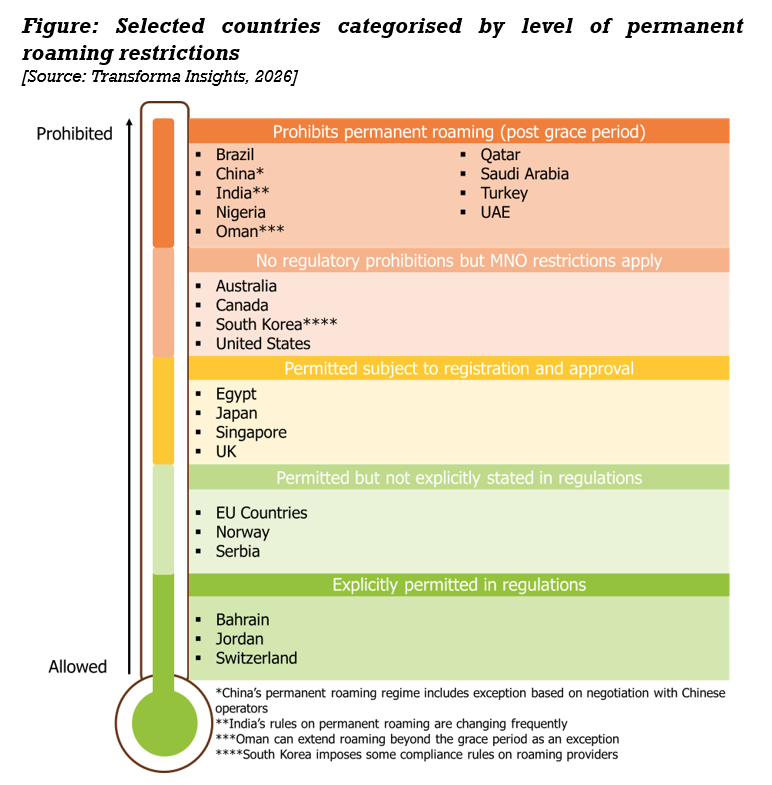
Permanent roaming: The need for seamless international connectivity is often enabled through roaming, which allows IoT/M2M SIMs to operate continuously across borders without switching to SIM credentials associated with a local operator. This ensures devices remain functional while complying with international deployment requirements. Roaming becomes ‘permanent’ when a device continuously operates on a foreign network for an extended duration, typically beyond 90-120 days. Permanent roaming regulations are particularly relevant for devices intended for cross-border supply, which may stay in the importing country for extended periods or even for the device’s lifetime.
Cellular device registration and associated taxes: These are regulations and other obligations related to registration of IoT hardware, mostly cellular IoT devices. For example, foreign cellular devices may need to have their IMEI registered with local authorities or network operators to access local networks beyond a certain grace period and potentially pay a fee.
eSIM provisioning: There is an increasing amount of regulation concerning who can provision eSIMs, and how eSIM data can be stored, transferred and shared. These rules are emerging for three main reasons: personal data privacy, and national data sovereignty and security.
Roaming fees: These are regulations related to fees for international (or national) roaming, including maximum and minimum fees. Wholesale roaming fees are charges that a home operator pays the visited operator so that home network devices can connect to visited networks. Retail roaming fees are charges that a home operator charges to their customers using networks in foreign country, or other visited network.
Know Your Customer (KYC) is also an important aspect of regulation to consider when deploying cross-border IoT solutions. This topic has been covered in detail in a separate report ‘The current status of Know Your Customer (KYC) regulations for IoT SIMs’.
As part of our examination of permanent roaming rules and guidelines, we approached regulators from over 80 countries to seek clarification on laws in their country and check for rules related to permanent roaming, roaming fees, operator resistance to permanent roaming, licensing for IoT and roaming fair use. The findings of this report are based on the responses received from these regulators combined with information available on regulator websites and government publications (or similar) identified through secondary research.