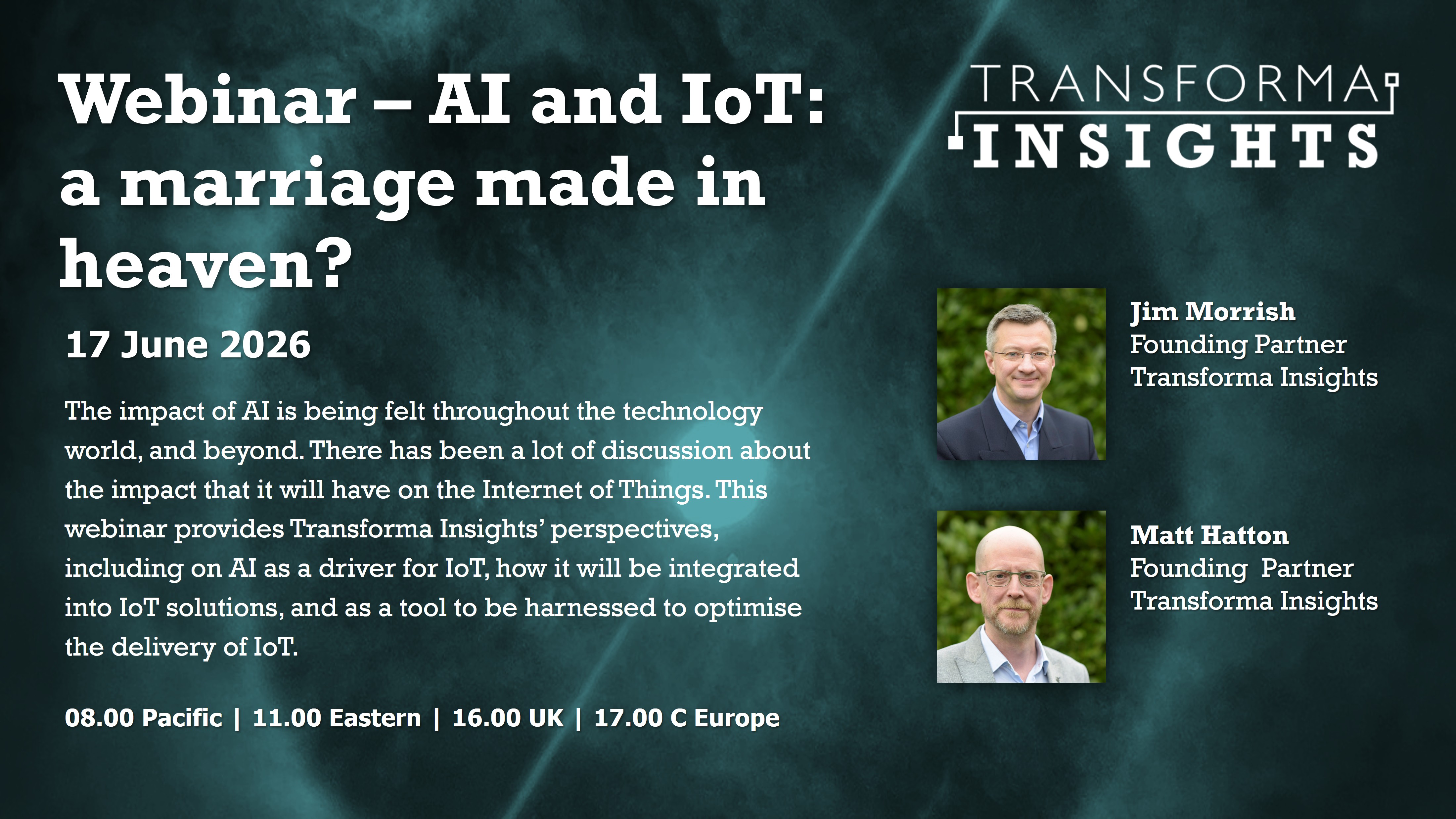
The impact of AI is being felt throughout the technology world, and beyond. There has been a lot of discussion about the impact that it will have on the Internet of Things. This webinar provides Transforma Insights’ perspectives, including on AI as a driver for IoT, how it will be integrated into IoT solutions, and as a tool to be harnessed to optimise the delivery of IoT.
The IoT community is increasingly looking at various aspects of Artificial Intelligence and the impact that it might have on driving IoT adoption, enhancing IoT solutions and optimising the delivery of IoT. Terms like ‘AIoT’ and ‘Physical AI’ have come to the fore recently to describe some aspects of this overlap.
Potentially, the impact is significant. Use cases involving predictive maintenance, anomaly detection and video analytics will clearly benefit from the application of AI, with expectations that it will drive uptake. Additionally, it has implications for how IoT solutions are deployed, with increasing demand for AI deployed on IoT devices and a corresponding impact on required connectivity performance. Transforma Insights has spent a lot of time recently tracking such AIoT opportunities. Furthermore there is a significant requirement to consider the orchestration of AI across the cloud, device, and intervening edge locations. The other major dimension is operational: how can AI be harnessed by the IoT vendor community to optimise delivery, and what are the tools and capabilities needed to support emerging use cases.
In this webinar, Transforma Insights will examine topics including the following, related to how AI and IoT intersect:
AI a driver for IoT adoption. Given AI’s ability to crunch larger volumes of data more effectively, what use cases – pertaining to IoT’s position at the intersection of physical and digital world – are enabled or expanded by the use of AI, and what new business models might be enabled?
AI on IoT devices. Where does it make sense for AI instances to be deployed directly onto IoT devices, and what are the implications of managing AI on those constrained AIoT devices (e.g. TinyML), and what platforms are required to do so? We will also explore how AI changes the interface between humans and AI devices.
Cloud-to-edge orchestration. AI orchestration will need to span a range of locations from the edge device through to the cloud and including campus and network edge. What will be the optimal approaches to managing the various compute resources in different deployment scenarios and using different types of connectivity including public and private networks?
Impact on the IoT hardware ecosystem. The need to support AI on edge devices drives a new market for hardware equipment with value-added capabilities.
Impact on supporting infrastructures. Support for AI in the field will place new demands on supporting platforms and infrastructures, including evolved IoT platforms and also cellular core networks.
Using AI to support IoT operations. Companies around the world are using AI for common processes such as customer support, task automation, and coding. Suppliers of IoT are using AI for these purposes but also many others. The webinar will explore uses related to security, compliance, connectivity, churn prediction and many others, including real-time optimisation.
The logistical challenges of harnessing AI. The arrival of the new functionality presents a number of operational challenges, for instance in adapting business processes or managing a mixed estate of devices.
A focus on video analytics. The webinar will use the example of the increasingly interesting field of AI-enabled video analytics to illustrate the various evolving components of IoT in an AI context, and the associated new market dynamics.
The webinar will take place on the 17th June at 08.00 Pacific / 11.00 Eastern / 16.00 UK / 17.00 Central Europe.